I am back in Delhi, and these polluted, clogged streets have never smelled so good nor seemed so cosmopolitan.
Four days in Varanasi was a lot. Now, while the city is an absolutely fascinating place, it is emotionally taxing and hard to navigate. Varanasi is one of the oldest continuously inhabited cities — it was founded around 13-12 B.C., according to legend, by Shiva. So naturally the entire city revolves around death. It is the holiest of the 7 holy cities in Hinduism and therefore it is a big pilgrimage site. And devout Hindus go there to die.
The old city, where I stayed, is filled with winding narrow streets that lead to the river. Streets may be a generous term, alleyways is perhaps more accurate. I believe someone around 5’10” could lie down and probably touch both walls on either side in most of them.
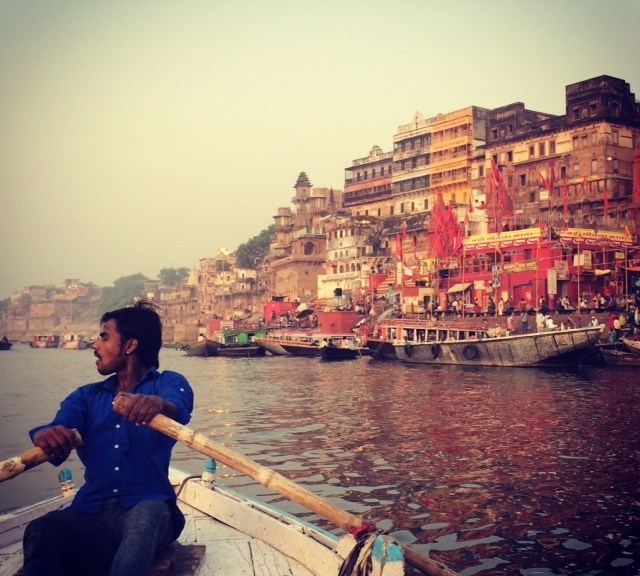
The river is lined with ghats, stairs that lead down into the water, of which there about 100. (Ghats are different from temples, of which there are also many).
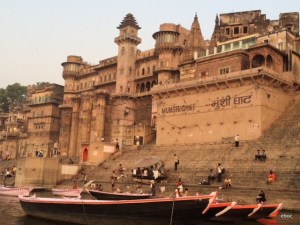
There are hospices along the river banks where the sick wait for death. Then they are burned at the two burning ghats, the most famous of the two is called Manikarnika, and their ashes are dumped in the river.
According to locals, 300 bodies are burned a day, and the fires burn all night. The only bodies that are not burned are those of holy men and pregnant women. They are wrapped and tied down with rocks and thrown in the river. I also learned that it takes about 300 kg of wood to burn a body completely. There are stacks of wood all around the Manikarnika Ghat, and all of the surrounding buildings have turned black from all the smoke.
The dead bodies are handled by outcasts, who prep the bodies and burn those who do not have any family. They also go out to retrieve people who have died in their houses or in surrounding villages. It’s a strange sight to see a corpse wrapped in an orange cloth strapped to the top of an auto-rickshaw.
Cars and tuk-tuks are not allowed in the old city, because the streets are too narrow. So people carry the bodies down to the river. There is a shop that makes delicious lassis on the route they take. If you sit there long enough finishing your lassi, you will see 5 or 6 bodies go by.
However, about 100 yards away from both of these burning ghats, pilgrims and the poor go down to the river every morning at sunrise and bathe in the river. The pilgrims do it to cleanse their souls, and the locals do it because it’s probably their best option. Kids swim in the river and use it as their playground.
Of course, let’s not forget that cows are considered holy In Hinduism. Although they walk around freely in every Indian city, Varanasi is particularly overrun with cows. In addition to the female cows, there are bulls, dogs, goats, and water buffalo. Most days we caught glimpses of monkeys, too.
In the winding narrow streets you can run into one cow at any turn or an entire herd of cattle. The animals are not very well taken care of and just hang out in the streets. So not only are there a lot of sick people in Varanasi, there are also a lot of sick cows. The dogs are covered with fleas and often look like they are about to keel over. I’ll leave it to your imagination to fill in the details about what coats the streets.
Sanitation is not big in a lot of the third world, but between the garbage, dirty water and sick animals loosing their bowels all over the place, walking around is a real adventure. Compound this with the fact that it was 95 degrees Fahrenheit by 11 am and 100-104 by 1 pm. We tried not to think too much about where the water in the shower at our hotel was coming from.
Every night at 6:30 p.m. there is a festival at the Dashashwamedh Ghat, which was quite near our hotel. This was fun to watch: 5 Brahmin priests perform the aarti ritual in a highly choreographed ceremony. It feels a bit like a circus, but they put on a good show for the pilgrims.
A lot of the other tourists in Varanasi were Indians. Even normal Indians think it’s a bizarre place and something of a spectacle.
I took a walk to the southernmost ghat along the river and passed the smaller burning ghat, where I came across a Brahmin funeral. Women are not allowed to attend funerals; they have to watch from above, because of several sexist reasons. However, one of the principle reasons is that if someone cries at a funeral, the soul of the dead will not be set free… it will stay attached to its family members. So typically the oldest son performs the funeral rites and then lights the pyre on fire.
The ritual was fascinating; the priest recited several passages, the son circled the body with water from the river and then he laid flowers on the body, etc. He kept it together very well, but as he walked past us he wiped away a tear, which was actually very nice because I was beginning to get depressed by how commercial and impersonal the death industry is in Varanasi.
I took two boat rides on the river that were very peaceful and pretty. I took one on my first morning to watch the sunrise rituals and another a few days later in the evening to see the northern ghats, which are further away and hard to walk to from where I was staying.
Varanasi is not only important to Hindus, it is also important to Buddhists. I took a trip out to Sarnath, about 11 km from Varanasi, which is where the Buddha gave his sermon on dharma and the sangha, his following, formed. 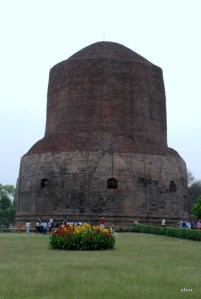
There are a couple of Buddhist temples and a Buddhist university where the Dalai Lama speaks once a year.
Not to be outdone, the Muslims are also well represented in Varanasi. Aurangzeb, the last great Mughal emperor (who deposed his father Shah Jahan, the man who built the Taj Mahal), tried to conquer Varanasi and built a very pretty mosque at the top of one of the ghats. We were assured that there is no religious tension in Varanasi, the 4 police officers stationed outside the main Hindu temple 24/7 notwithstanding.
Traffic in Varanasi was abysmal, as opposed to Delhi and Jaipur, which is just extremely unpleasant. This is partly because the primary is going on and Modi seems to be doing well in Uttar Pradesh East – a heavily Hindu area. Security was really ramped up and I’ve also noticed more police in Delhi this go around.

All that aside, it was a great place to visit and an excellent place to learn more about Hinduism.





















 elizabethboconnell