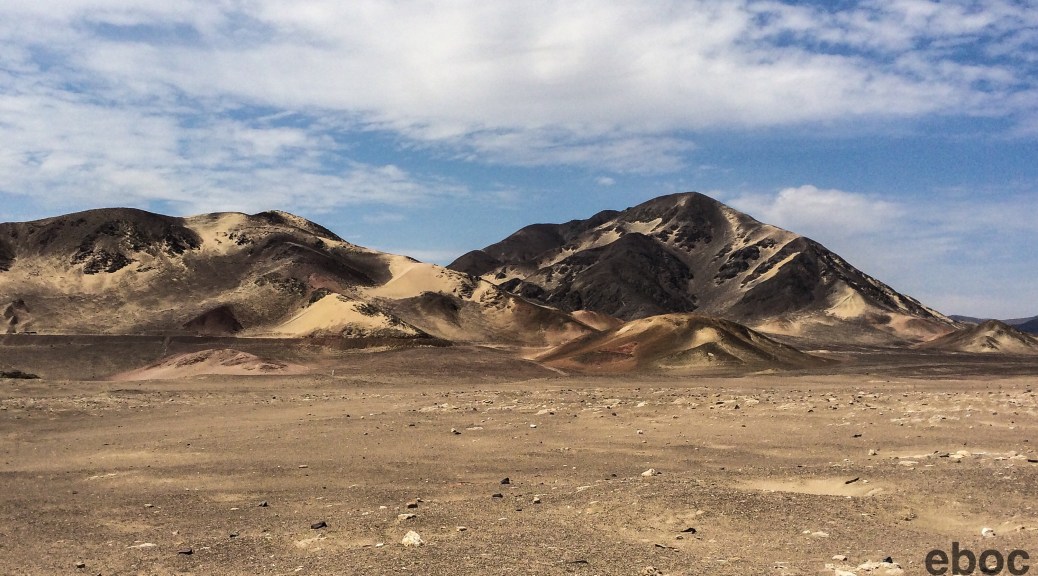
Nazca, Ica Region, Peru: Night buses are brutal, but to get to Nazca it was the best way to travel. Continuing my tour of strange defunct cultures in Peru, the Nazcan geoglyphs certainly qualify as bizarre.
Getting off the bus at 8 am I was hit in the face with 95 degree heat. But man did it feel good to be back at sea level!
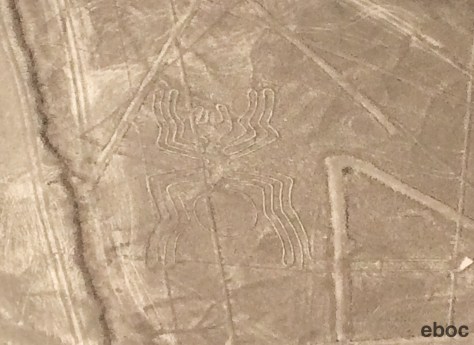
My first morning I took a flight in a teeny tiny Cessna. The flight lasted half an hour, and the pilot was a bit stingy when it came to flying over the sites twice (once to the left, once to the right), but it was amazing to see the scale of the lines.

The lines take up 500 square kilometers in the middle of desert. The Nazca people scrapped 10-15 cm off of the top layer of iron exposing white stone below. The iron keeps the lines warm during the winter and a hard shell, formed over the lines, protects them from sandstorms.
In the afternoon, I went to see the oldest aqueducts still in use. The Nazcans built them 2000 years ago, and they are still used to irrigate farms. There are only about 20 aqueducts still in use, but in Nazca’s heyday the system had more than 300.
I also saw the remains of an Incan administration building.
No one in Peru seems to like each other: even though there is a strong sense of national identity. The Cusqueños don’t like people from Lima; Arequipeñas don’t like anyone, and the Nazcans don’t like the Cusqueños because the Incas invaded and wiped out the Waris – the successors to the Nazca Empire.
Like most Incan ruins, it was pillaged for adobe bricks so the locals could build their houses.
More depressing, the next day I went to a cemetery that has been heavily picked over by grave robbers.
Many of the mummies remain, but their jewelry and much of the pottery is gone.
In the afternoon I went to the tower from which it’s possible to see the hand and tree geoglyphs.
Nearby is a museum dedicated to Maria Reiche, the mathematician who devoted her life to studying the lines. She also fiercely protected them; although she was unable to stop the Peruvian government from building the Pan-American highway across several of the lines.
Maria Reiche developed the theory that the lines were part of an astronomical calendar. Nearby the tower is a hill. From the top of the hill, the sunset lines up with one of the lines on the Winter Solstice: June 21.
Since she died no one has continued her research.
 elizabethboconnell