
Puno, Puno Province, Peru: On Wednesday morning there was a strike on Peruvian-Bolivian border that complicated the border crossing.
So I stayed in Puno and went to the floating islands on Lake Titicaca to see the Uros people. (Fun fact about Puno: according to a guide, a lot of houses are unfinished so that inhabitants pay lower taxes.)

It is just as touristy as you would imagine. But unlike a lot of the floating islands in Vietnam these are still made out of reeds instead of plastic or fiberglass. There are some islands that have decided not to allow tourists.
The first island I visited had 20 people living on it. Ana, 54, lives with her husband in one of the huts on the island. Two of her five daughters still live on the island with their husbands while the other three have married and moved to other islands with their husbands.

Most of the older men work as fisherman on the lake, but the younger men go into Puno to work as taxi drivers or in construction.
The women stay on the islands to cook, change the reeds on the houses, or to add another layer of reeds to cover the island. They also have an opening in the island through which they farm fish.
There was one solar panel on the island near the kitchen. The other houses get hooked up to the solar panel. If the power goes out they have to light candles and put them in ceramic bowls to avoid the island catching on fire.

There were ten adults living in five huts. The rest were children of varying ages. On the islands the children go to school from ages 5 to 12. Since there is no high school, after 12 they have to go into Puno, which would probably take an hour each way.
Their diet consists mostly of fish that the supplement with rice and quinoa. They were fairly big women. On Saturdays they go into Puno to buy grains and milk for their babies.
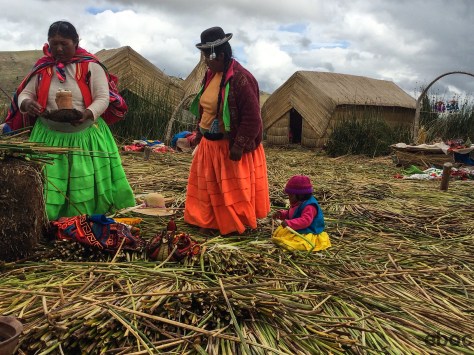
The babies chew on the end of the fresh reeds. The reeds are rich in calcium, and since they do not brush their teeth on the island chewing on the reeds helps their teeth to develop. The calcium is also good for their bones. They taste like watery bananas.

We went to a bigger island, which had a cafe and a little market. This island also had a garden on it with several potato plants.
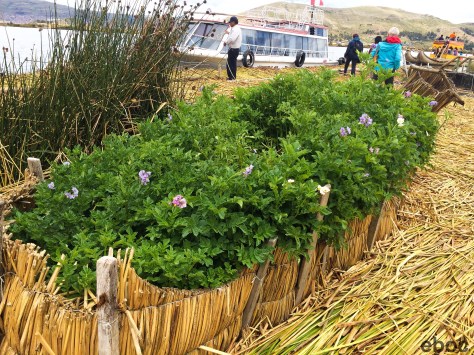
On the one hand it is cool that they continue to live as people have on Lake Titicaca for thousands of years. But on the other hand the lifestyle seems profoundly boring and hard.
In the afternoon, when I got back to Puno, I walked around the city. I passed by a bank and saw a line of women from the highlands dressed up in their city best waiting to cash their welfare checks.

 elizabethboconnell