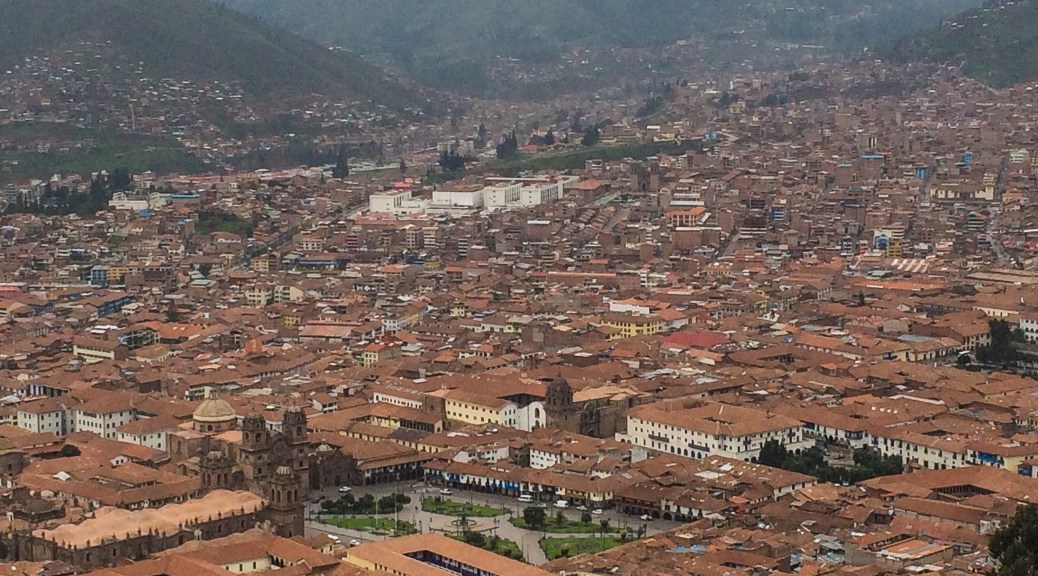
Cuzco, Cuzco Province, Peru: The biggest surprise of my trip has been Cuzco.
I heard everything from “its a dump” to “interesting provincial town.” And while it is not the capital, Cuzco is enormous and growing quickly thanks to tourism. There is a lot to see and do.
In stark contrast to my experience in Chile, when I first landed in the airport and was waiting for my bag by the carousel I felt unusually tall and out of place — until a group of German tourists walked into the room. The cusqueños are not tall.
The city has quadrupled in size in the last twenty years and now has close to 1 million people. I will admit that the newer part of the city is not the main draw.
In Quechua, Qosqo means center: it was the heart of the Incan empire.
From the look-out below the Christ the Redeemer statue you can still see that old city is in the shape of a puma.
The Plaza de Armas is beautiful: the Spanish did have a certain flair. It looks like it could be in Seville. The plaza has two big churches and is ringed by an arcade.
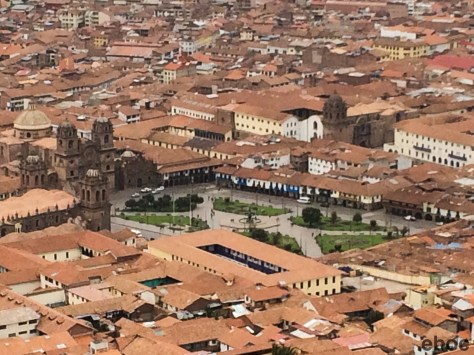
A few blocks away is the Convent of Santo Domingo. The conquistadors built the monastery and church on the foundations of an Incan Temple. The foundations are still impressive: the temple must have been monolithic.

Because the indigenous culture and language are still strong and vibrant in Cuzco and the surrounding region reminders of the Spanish conquest seem to hit harder than they do in Argentina or Chile. There is an anger that isn’t quite as evident in other parts of South America.
But that anger isn’t only reserved for the Spanish. Especially true in the mountains, the locals do not refer to Lima – they talk about the “Capital” and people from the Capital, like something out of The Hunger Games.
The day after we got back from the Incan Trail several of us from the tour went to a soccer game between Real Gracilaso and César Vallejo. The other team, César Vallejo, comes from the coast. As at all soccer games the trash talk was wonderful and colorful but the history of animosity between the two teams made it especially rich.
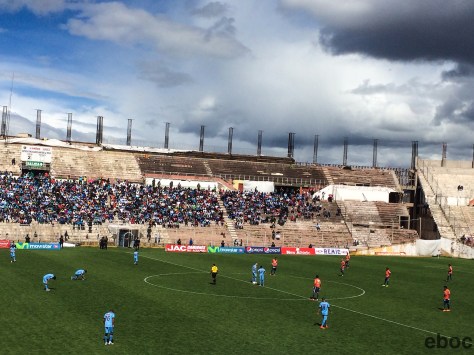
Some great fights broke out on the field. It felt more like a hockey game than a soccer match.
One aspect of the local culture I liked is that there is no word for goodbye in Quechua. The people say see you later, Tupananchiskama, whether in this life or the next.
 elizabethboconnell